Venus Flytrap Dionaea muscipula
How to Propagate Venus Flytraps at Home
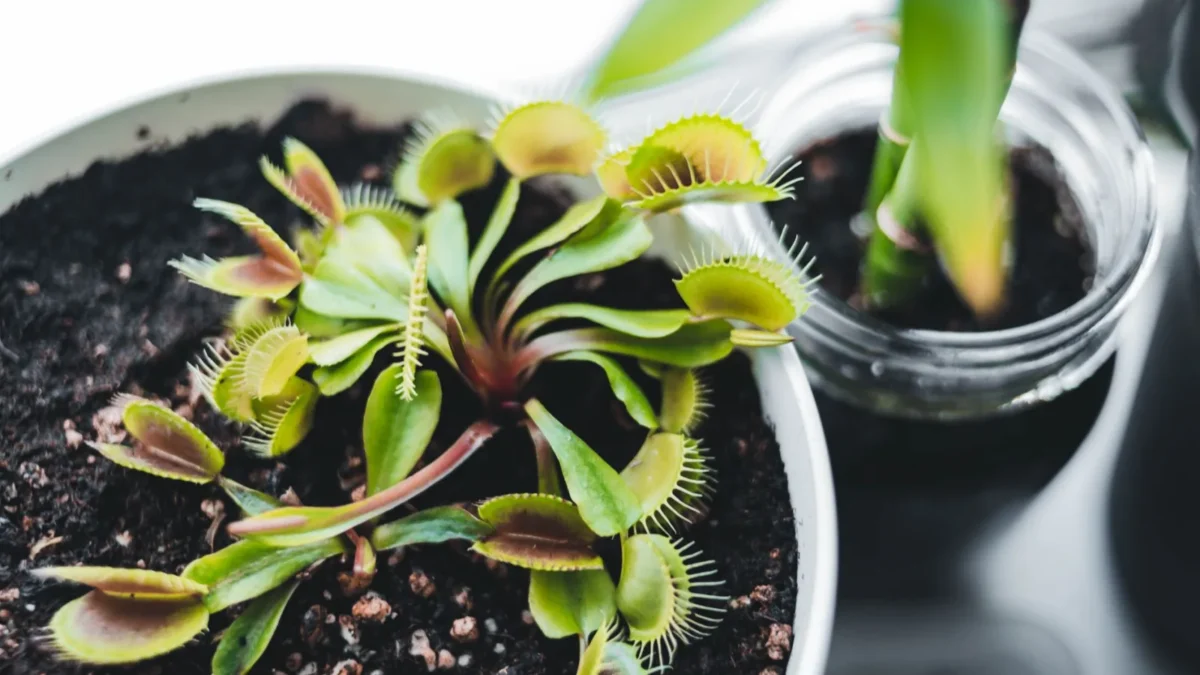
Quick answer: You can propagate Venus flytraps in three ways—leaf cuttings, rhizome division, or from seed. Leaf cuttings are the easiest for beginners and take about 6 months to produce a new plant. Seed sowing is slower but rewarding if you’re patient, while division works only if your plant has four or more crowns.
| Botanical name | Dionaea muscipula |
|---|---|
| Light | Full sun to partial shade; 12 hours optimal; south or west-facing exposure |
| Watering | Rainwater only; sit in 1 cm water saucer spring/summer, ½ cm winter; water from below |
| Humidity | Above 50%; thrive with humidity despite adapting to drier climates |
| Temperature | 10–27°C (50–80°F); cool winter dormancy above 10°C required |
| Soil | Half sphagnum peat/moss, half coarse horticultural sand; nutrient-poor only |
| Feeding | Never use fertilizer; gets food from insects; nitrogen causes root burn |
| Size | Up to 10 cm tall; 2–6 inches maximum height |
| Difficulty | moderate |
| Cats | ✓ non-toxic |
| Dogs | ✓ non-toxic |
Propagate Venus flytraps from leaf cuttings
Leaf cuttings are the most reliable method and the best starting point if you’re new to propagating these carnivorous plants.
In early summer, remove a healthy leaf by pulling it down and out until it separates with a bit of rhizome attached at the base. Plant the cutting in its own pot filled with a carnivorous plant potting mix (half sphagnum peat or moss and half coarse horticultural sand) and cover the pot with clear plastic to trap humidity.
Keep the cutting moist using the water tray method—sit the pot in 1 cm of rainwater so it absorbs from below. Place it in bright, indirect light with at least 12 hours of light daily.
Once the leaf turns black, trim it away carefully. A new Venus flytrap plant should sprout in its place in about 6 months. The new plantlet will be tiny—mature Venus flytraps max out at 10 cm tall.
Grow Venus flytraps from seed
Seed propagation is slower but works well if you can provide the right conditions. Sow seed at 10–13°C in spring; place the container in a water tray to keep the growing medium moist. Germination is often very slow, so patience is essential.
Use only rainwater or distilled water—tap water kills Venus flytraps. Maintain the temperature between 10–27°C (50–80°F), keeping the medium consistently damp but not soggy.
Propagate by division
This method only works if your Venus flytrap is large and established. Venus flytraps can be propagated by division of large clumps with four or more crowns.
Make sure each division has a healthy nest of roots and at least one trap, and plant it immediately in its own pot with a lean potting mix that’s appropriate for carnivorous plants. Never use regular potting soil or fertiliser—nutrient-rich soil will burn the roots.
FAQ
Can I propagate a Venus flytrap leaf without a bit of rhizome attached?
No—the rhizome portion at the base is essential for successful propagation. Always pull the leaf down and out to ensure you get that bit of rhizome attached.
How long until my propagated Venus flytrap is mature?
A new plant from a leaf cutting takes about 6 months to develop, but it will still be very small. Seed-grown plants take even longer and germinate slowly.
What potting mix should I use for my new plant?
Use half sphagnum peat or moss and half coarse horticultural sand. Never use regular potting soil, as minerals will burn the roots and kill the plant.
Read the full guide: Venus Flytrap Care: The Complete Guide
More about Venus Flytrap
The same problem in other plants
- How to Propagate Asparagus Fern at Home
- How to Propagate Ficus Audrey from Cuttings
- How to Propagate Staghorn Fern: A Complete Guide
- How to Propagate Philodendron Micans: The Easiest Methods
Sources
- How to care for a Venus flytrap
- Venus Flytrap Care: How to Grow This Carnivorous Houseplant
- Venus Flytrap Indoor Care Guide with Downloadable Care Sheet
Photo: Erik Mclean / Pexels, Pexels