African Violet Saintpaulia
How to Propagate African Violets from Leaves
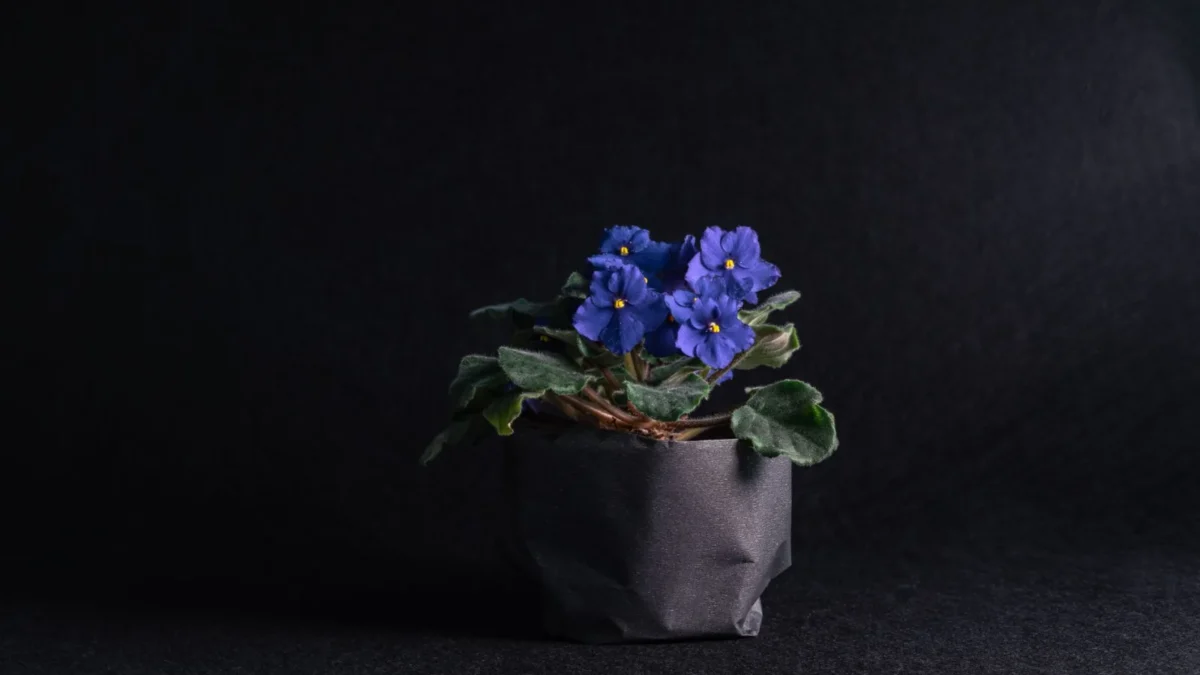
Quick answer: You can propagate African violets by snipping off a healthy leaf with its stalk, inserting it into free-draining compost, and covering the pot with clear plastic. New plants will form at the base of the leaf in about a month, making it one of the easiest ways to multiply your collection.
| Botanical name | Saintpaulia |
|---|---|
| Light | Bright indirect light; 14-16 hours daily for flowering; avoid direct midday sun |
| Watering | Keep soil evenly moist like a well-wrung-out sponge; water when top soil is dry; drain saucers after 1 hour |
| Humidity | 40-60% humidity; use pebble trays; avoid misting fuzzy leaves |
| Temperature | 60°F at night; 80-85°F during day; avoid cold drafts and temperatures below 60°F |
| Soil | Soilless mix: 3 parts peat moss, 2 parts vermiculite, 1 part perlite, plus lime |
| Feeding | Dilute balanced fertilizer (20-20-20) at each watering; high phosphate-potash during heavy bloom |
| Size | Standard: 8-16 inches wide; miniature/semi-miniature under 8 inches; large over 16 inches |
| Difficulty | easy |
| Cats | ✓ non-toxic |
| Dogs | ✓ non-toxic |
Leaf Cutting Method: The Easiest Way to Propagate African Violets
Propagating African violets from leaves is straightforward and remarkably reliable. This method works because a single leaf contains all the genetic information needed to grow an entire new plant.
Here are the steps:
- Choose a leaf that is almost full size and remove it with the stalk (petiole) attached.
- Fill a small pot with free-draining compost—a mix of 3 parts peat moss, 2 parts vermiculite, and 1 part perlite works well.
- Insert the leaf stalk into the compost so the base of the leaf just touches the surface.
- Place the pot in a propagator or cover it with a clear plastic bag to create humidity.
- Provide bright but not direct light and keep the temperature around 65°F (18°C).
- Water about twice a week—this is crucial, as leaf cuttings are prone to rotting if the compost stays too wet.
- Remove any decaying leaves promptly to prevent grey mould.
New plants should form at the base of the leaf in four to five weeks. Once you see baby plantlets emerging, you can gradually remove the plastic covering to acclimate them to normal humidity.
Best Timing and Why Spring Works Well
While African violets can be propagated year-round, they grow most readily from leaf cuttings in spring. The warmer temperatures and longer days support faster root and plantlet development. That said, with proper light and warmth, you can succeed at any time of year—just be more patient in winter months, as development slows at low temperatures.
Common Mistakes to Avoid
The biggest mistake is overwatering. Leaf cuttings are prone to rotting off if the compost is too wet, so resist the urge to keep them soggy. Watering twice a week is sufficient.
Don’t use cold water—use tepid water instead. Also, be patient with low temperatures. Development will slow significantly if conditions are cooler than the recommended 65°F, so ensure your propagation area stays warm.
Finally, remove any leaves that begin to decay immediately. This prevents grey mould from spreading and damaging your cuttings.
FAQ
Can you propagate African violets from leaves in water?
The standard method uses free-draining compost rather than water, as this prevents the cutting from rotting. Water propagation is not the recommended approach for African violets.
How long until the new plant is ready to pot up?
New plantlets typically form in four to five weeks, but wait until they are small but clearly formed before carefully moving them to their own pot. This usually takes an additional 2-3 weeks.
Read the full guide: African Violet Care: The Complete Guide
More about African Violet
The same problem in other plants
- How to Propagate Croton from Cuttings and Leaves
- How to Propagate Bromeliads from Pups: Step-by-Step Guide
- How to Propagate Anthurium: A Step-by-Step Guide
- How to Propagate Christmas Cactus from Cuttings
Sources
- African violets (streptocarpus) / RHS Plant Guide
- How to grow African violets / RHS Growing Guide
- Saintpaulia ionantha – Plant Finder
Photo: Mikhail Nilov / Pexels, Pexels